
Every home to EPC C. For less, and how likely.
For every home below EPC C in England and Wales, Viiyoo reads two routes from the home's own certificate: the register's own, and the cheapest route Viiyoo has tested. Each comes with a cost range at today's prices and a tested chance of reaching C. Across a portfolio, the plan expects as many homes at C as the register's routes would, for less.

Real Viiyoo screen from a demo organisation: a 500-home book, 220 below C. The saving is this plan's own figure; each plan states its own.
- Same homes at C the plan matches the register's own expectation
- For less one route chosen per home, cheapest first where it holds
Government policy, with its source.
Private lets, England and Wales
Government policy (21 January 2026, subject to legislation): privately rented homes must reach EPC C by 1 October 2030. A home rated C on its current certificate before 1 October 2029 counts until that certificate expires. Landlords need spend no more than £10,000 a home.
Social homes, England
Government policy (1 April 2026): social homes must reach EPC C on one of the new EPC metrics by 1 April 2030. A home rated C on its current certificate before then counts while that certificate is valid.
Today's rating
Viiyoo's routes are to C on today's rating. The standard after 1 October 2029 uses new EPC metrics not yet published, which these routes do not model. Each date is shown with its source and the day it was checked.
Two routes, side by side, on the home's own page.
- The register's route and Viiyoo's. Measures in order, as worded on the certificate, with the score each route reaches.
- Costs as ranges. Indicative costs at today's prices, and a modelled saving a year that is not a bill. Not quotes.
- A tested chance. A word and a percent together, "likely (71%)", tested on homes assessed twice.
- Cost per expected C. The figure that compares routes fairly, and where each sits against the £10,000 cap.
- Homes like this. The share of similar homes that reached C after similar work, with how many homes it rests on.
- Every state in words. C or better already, no certificate, a certificate over ten years old: each said plainly, never left blank.
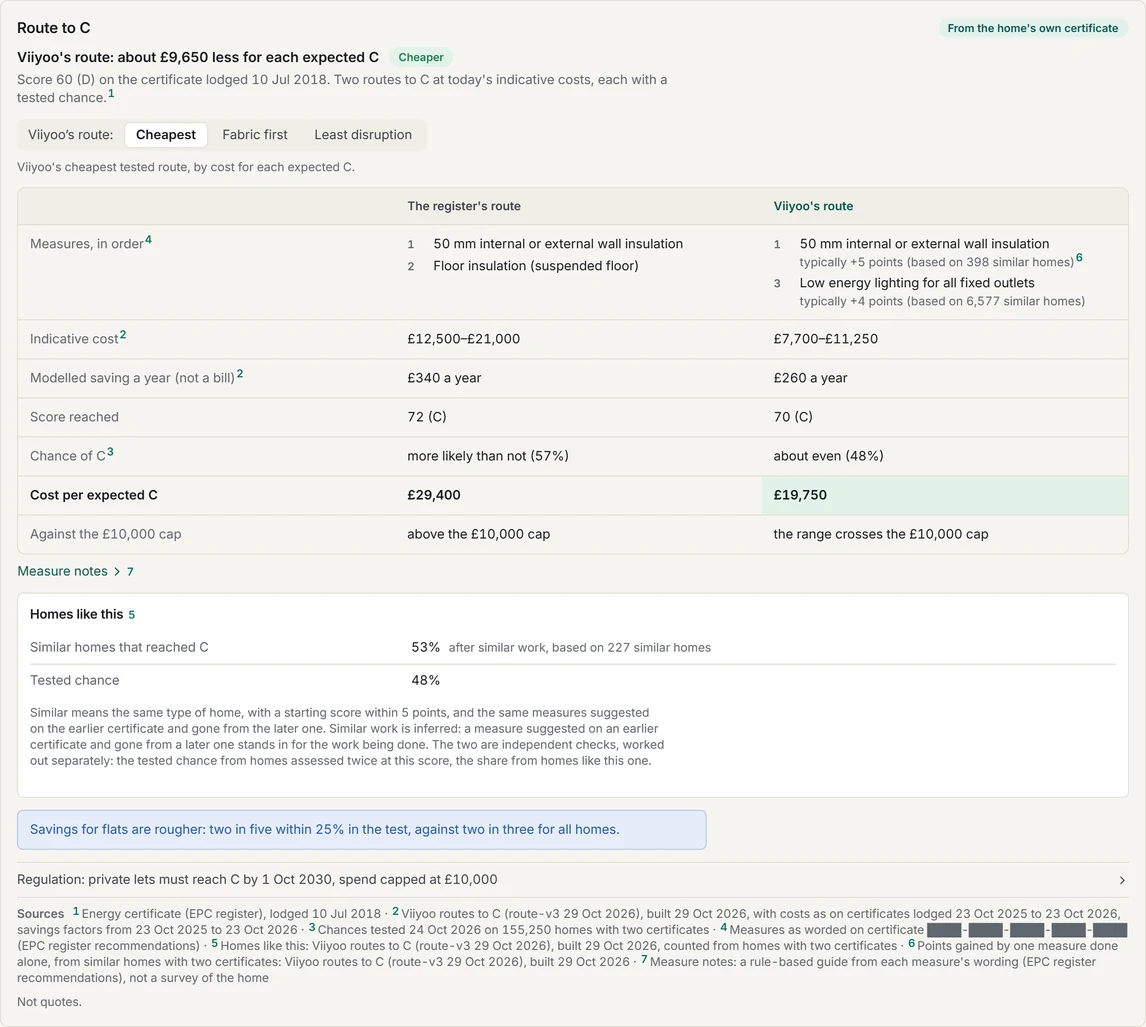
Real Viiyoo screen. The certificate number is hidden here; in the app every figure links to its source.
The bill for the book, and the order to do it in.
Run it on a held portfolio, or hand over a list of addresses as an engagement. Viiyoo chooses one route per home so the book expects as many homes at C as the register's own routes would, for the least.

Move the budget and see how many homes it is expected to bring to C.
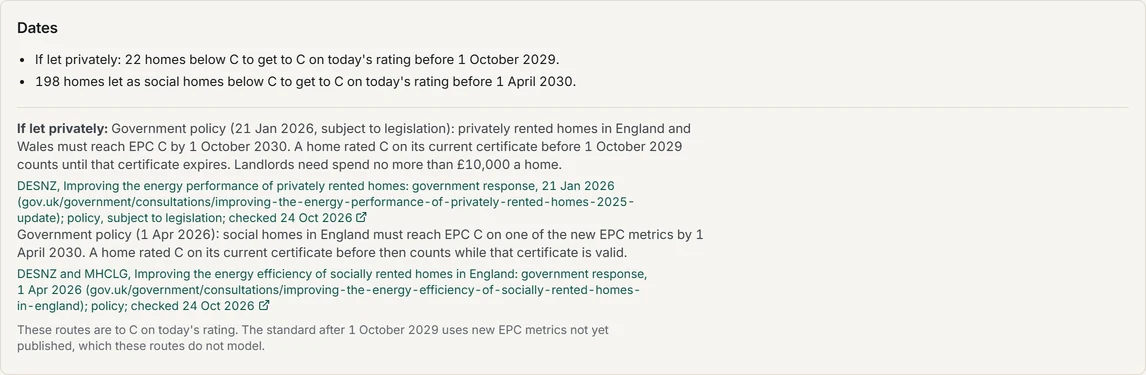
The homes each date applies to, with the policy and its source.
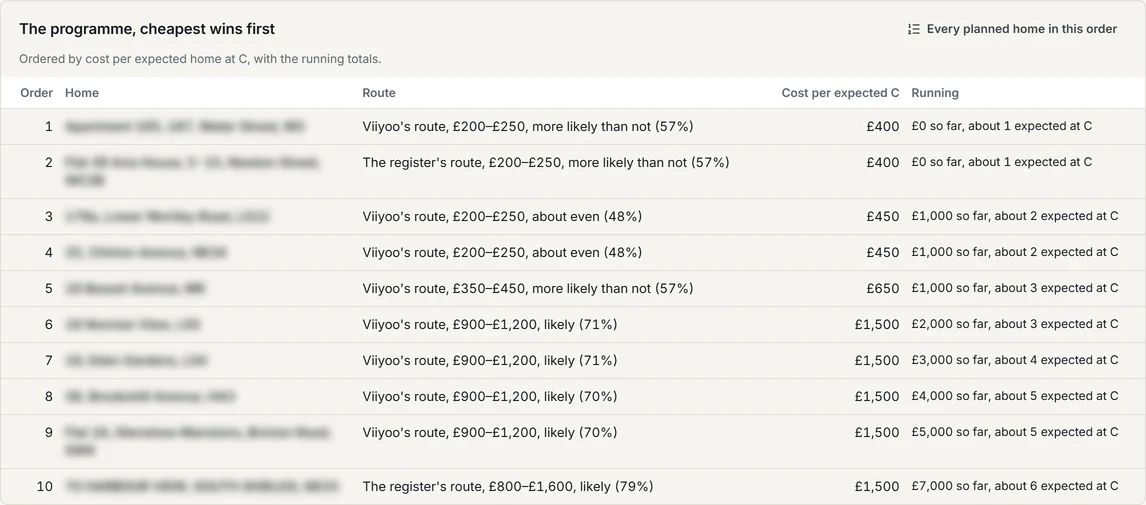
Real Viiyoo screens from a demo organisation. Addresses are blurred. The bill comes as a pack (PDF), a workbook and a CSV, each marked "Not quotes".
In the rules you buy by, when you choose.
On mandates and screens
Switch on an energy rule and every home a plan, a screen, a search or a scenario reads carries its route to C and what it would cost. Off by default, so nothing else changes.
For a held portfolio
A Route to C tab on the book you hold, and the plan kept, so a later run on new costs shows what moved.
As an engagement
Hand over a list of addresses or reference numbers and get the bill back, released by your own person like any other engagement.
What it is, and what it is not.
Are the costs firm prices?
No. Costs are indicative ranges from the register at today's prices, and every surface says "Not quotes". A survey and a contractor's price come before any work.
How sure is a route?
Viiyoo gives a tested chance, never a promise: a word and a percent, from homes assessed twice. Some routes are more likely than others, and the plan expects a number of homes at C rather than naming each one.
Does Viiyoo decide whether a home meets the standard?
No. Viiyoo shows routes, costs and chances against the dates in government policy, with their sources. Whether a home meets a standard is for you and your advisers.
What about the new EPC metrics?
The routes are to C on today's rating. The standard after 1 October 2029 uses new metrics that are not yet published, and the routes do not model them; each surface says so.
Which homes does it cover?
Homes in England and Wales with an energy certificate. A home without one is said plainly, "needs an assessment", and Scotland's separate regime is not covered.
Who can see a bill?
Only your organisation, inside the signed-in platform. Each home planned counts once a month towards your plan's homes analysed; moving the budget or downloading counts nothing.
See the route to C for your own book.
Send us the homes you hold, and we will show you the bill: the register's routes against the plan, what each budget buys and the order to do it in.